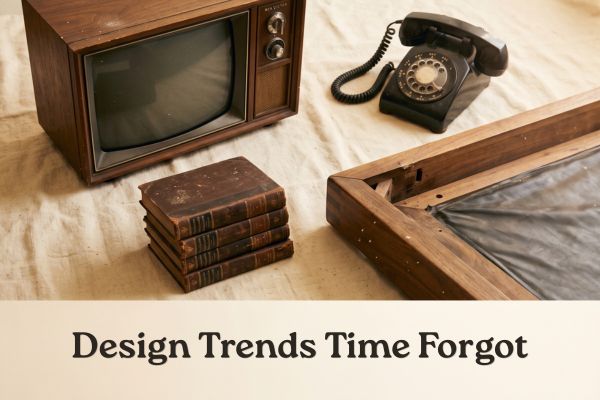
Design Trends Time Forgot
There's a very specific kind of memory jolt that happens when you see a photo of a console TV cabinet, or a landline nook built into a hallway wall, or a wet bar sunk into a corner of someone's basement. You forgot these things existed.
Not because they were rare — because they were everywhere, for exactly long enough to feel permanent, and then they weren't. This is a running list of the design features, rooms, and objects that disappeared from American homes, in the order the channel covers them.

What this guide is
Unlike the Decades and Then vs Now guides, this page reads more like a list than a narrative — which fits the subject. Each entry below covers one thing the channel has declared officially "lost," in the order its episode publishes, with a link slot for the video and, where solid data exists, the actual numbers behind its disappearance.
Some of these trends have hard statistics attached; others are better documented through cultural and news coverage than sales data. Both are noted honestly rather than padded to look more rigorous than they are.
The Sunken Living Room

Also known as the conversation pit, the sunken living room peaked in the 1950s and '60s and was already being described as "on the way out" by a 1963 TIME magazine piece (Home Stratosphere). Its decline tracked almost exactly with the rise of television in the American living room — as homes shifted from spaces built around conversation to spaces built around a screen, the recessed, inward-facing seating stopped making sense (Hunker). Many were simply filled in during later renovations to create a flat, uniform floor.
The Department Store Christmas Window

The elaborate holiday window display was, for decades, a genuine civic event — families would travel downtown specifically to see them. Their decline tracks the broader decline of the American downtown department store itself, as anchor retail shifted first to suburban malls and later to e-commerce, leaving fewer flagship storefronts with the budget or foot traffic to justify a full seasonal production.
The Console TV Cabinet

The console TV — a television built into a full piece of wood furniture, often doubling as a stand for photos or a home bar — was less a technology than a piece of furniture that happened to have a screen in it. Flat-panel TVs made the cabinet's core function (hiding a bulky cathode-ray tube) obsolete almost overnight in the 2000s, and wall-mounting removed the need for a "TV stand" as a furniture category at all.
The Landline Phone Nook

The built-in wall nook for a landline phone — often with a small shelf or seat attached — is one of the more visible casualties of the smartphone era. As of 2026, roughly 78% of U.S. households are wireless-only, up sharply from just a few years earlier, with landline use now concentrated heavily among adults 65 and older (NumberBarn). The nook itself became a dead architectural feature well before most homeowners got around to remodeling it away.
The Encyclopedia Set on Display

Few objects signaled "we are a serious, educated household" quite like a full multi-volume encyclopedia set on a living room shelf. Encyclopaedia Britannica's print sales tell the story precisely: the top year for the printed set was 1990, when 120,000 sets sold — a number that had fallen to just 40,000 only six years later, and the company printed its final physical edition in 2010 before formally ending print publication in 2012 after 244 years (Computerworld).
The 90s Video Arcade

U.S. arcade revenue peaked around $8 billion annually in the early 1980s. Home consoles chipped away at that lead for over a decade, and the arrival of PlayStation-generation graphics in the mid-1990s finally closed the quality gap that had justified a trip to the arcade in the first place — by 1999, national arcade revenue had fallen to roughly $1.3 billion (Bitvint). Rising mall rents and collapsing mall foot traffic finished the job through the early 2000s.
The Roadside Motel

Independent, mom-and-pop motor courts peaked at around 61,000 operating locations in the U.S. in 1964. By 2012, that number had fallen to roughly 16,000, according to research cited by the Smithsonian (Smithsonian Magazine). The Interstate Highway System is the primary cause — new interstates routinely bypassed the small towns and old highways these motels depended on, and later decades added rising crime concerns and the rise of standardized chain hotels as further pressure.
The Home Wet Bar

The built-in home wet bar — a sink, small fridge, and liquor display integrated directly into a living room, den, or basement — was a fixture of the entertaining-focused floor plans of the 1960s and '70s. As home layouts shifted toward open-concept kitchens that already function as a natural gathering and serving point, a dedicated, separately plumbed bar area became redundant square footage rather than a selling point.
The Waterbed

At its peak in 1987, roughly one in five (some sources say one in four) mattresses sold in the U.S. was a waterbed, in a market worth an estimated $2 billion (Apartment Therapy). By the early 2010s, waterbeds had fallen to less than 5% of new bed sales (Wikipedia). The practical case against them was substantial: leak risk, the difficulty of moving hundreds of pounds of water-filled vinyl, and landlord bans in many rental buildings — advances in memory foam gave consumers a comparably soft alternative without any of that maintenance.
The Video Rental Store

Blockbuster peaked in 2004 with over 9,000 stores worldwide and roughly 84,300 employees. The company filed for bankruptcy in 2010, and its last corporate-owned stores closed by 2014 — done in by DVD-by-mail and streaming competition it was slow to take seriously (Oregon Encyclopedia). A single franchise location in Bend, Oregon remains open today, now more tourist attraction than going concern.
Why These Things Actually Disappeared
Looking at this list all at once, a pattern shows up that isn't visible episode by episode: almost nothing on it vanished because people simply stopped liking it.
Each one was pushed out by a specific, identifiable shift — a technology that did the same job better (flat screens, memory foam, streaming), a change in how homes are laid out and used (open floor plans absorbing the wet bar and the conversation pit), or an outside infrastructure shift that made the old version pointless (interstates bypassing motels, cell towers replacing the phone nook).
Nostalgia tends to flatten all of this into "things were better made back then" or "trends just come and go" — the actual story is almost always more specific and more interesting than that.
The List That Never Finishes
Every generation loses something it assumed was permanent. Right now, somewhere, there's a feature of a 2020s home that a future version of this list will eventually cover — something nobody currently thinks to miss because it hasn't disappeared yet. That's really what this page is keeping track of: not a closed set of dead trends, but an ongoing one.
