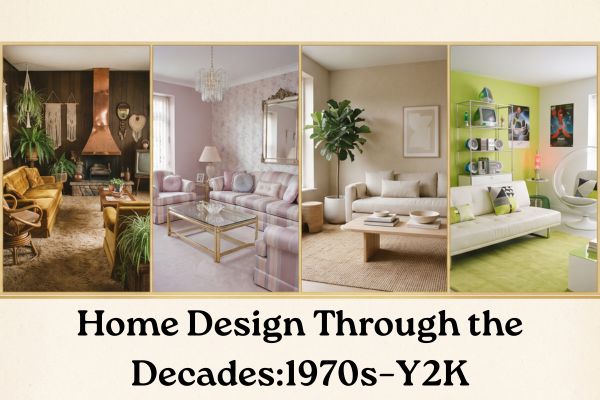
Home Design Through the Decades: 1970s–Y2K
Picture it: shag carpet underfoot, a console TV humming in the corner, a bowl of hard candy nobody was allowed to touch sitting on a glass coffee table. Or maybe your memory skips forward — beige walls, a single abstract print, a home that looked like it was trying very hard not to have an opinion.

Every home tells you what its decade believed about comfort, status, and what a family was supposed to look like when company came over. This is a running guide to that story, room by room, decade by decade — and it grows every week as new episodes go live.
📺 New episodes start September 4th. Every Friday, a new Interior Time Capsules video breaks down one more piece of this story — this week it's the living room. Subscribe on YouTube so you don't miss the one that started it all.
What this guide is
This page is the home base for every Decades episode on the channel — not a finished history, but a living index that fills in as new episodes publish. Each section below covers one era's defining rooms, materials, and colors, with a link slot for the companion video once it's live. Check back weekly, or better yet, get the Sunday Story in your inbox and never wonder what you missed.
The 1970s: Earth Tones and the Coordinated Kitchen
Before this decade, a kitchen was just a room full of white machines. In the late 1960s and through the '70s, appliance makers started treating it as a styled space — GE introduced avocado green to its lineup in 1966, and harvest gold followed a couple of years later (House Digest).

By the middle of the decade, avocado had become instantly recognizable — even KitchenAid added it to their stand mixer lineup in 1970 (Home Stratosphere). Wood paneling, sunken living rooms, and the home wet bar rounded out a decade that wanted rooms to feel warm, textured, and a little theatrical.
The 1980s: Bigger, Brassier, and Built to Impress
If the '70s was about warmth, the '80s was about showing off. Kitchens got bigger, brass fixtures multiplied, and — at the national level — home prices were climbing fast: the median U.S. home value rose from roughly $47,200 in 1980 to $79,100 by 1990 in unadjusted dollars (U.S. Census Bureau). It's also the decade that made the shopping mall a cultural institution — more on that below.

The 1990s: The Beige Reset
After two decades of bold color, the '90s pulled back — hard. Beige, cream, and "greige" walls became the default, open-concept layouts started replacing formal, closed-off rooms, and the console TV cabinet reigned as the living room's centerpiece. Housing costs kept climbing steadily through the decade too, part of a longer trend the Federal Reserve's historical housing data tracks back to the early 1960s.

Y2K: Metallics, Optimism, and a Little Bit of Chaos
The turn of the millennium brought a swing back toward maximalism — chrome and silver finishes, bold lime and hot-pink accents, and a design language rooted in techno-optimism about the future (Wikipedia: Y2K aesthetic). It's also, notably, the era currently having its moment again — Y2K is one of the most-searched nostalgia aesthetics online right now, which makes this the one section of the guide most likely to double as a "why is this trending" explainer for newer readers.

Beyond the Living Room
This guide started in the home, but the channel doesn't stay there. Decades content will keep expanding into hospitality and retail spaces — malls, diners, hotel lobbies — because the story of how we decorated our homes is inseparable from the story of where we spent our time outside them.
Shopping malls, for instance, went from a novelty to a cultural fixture almost overnight: by 1990 there were over 1,500 malls in the U.S., accounting for more than 30% of all retail sales, and in 1986 Consumer Reports had already named the mall one of the 50 innovations that most changed American life (Camoin Associates).

Expect this section to grow its own set of decade breakdowns as those episodes publish later this year.
How to Follow Along
New Decades episodes publish roughly every few weeks as part of the channel's weekly rotation. This page updates every time one goes live, so bookmark it if you want a running record rather than catching episodes one at a time. For the deeper research behind each one — source notes, price comparisons, the details that didn't make the final cut — that's what the Sunday Story newsletter is for.
New episodes start Friday, September 4th. Subscribe on YouTube to catch the first one as soon as it drops.
